
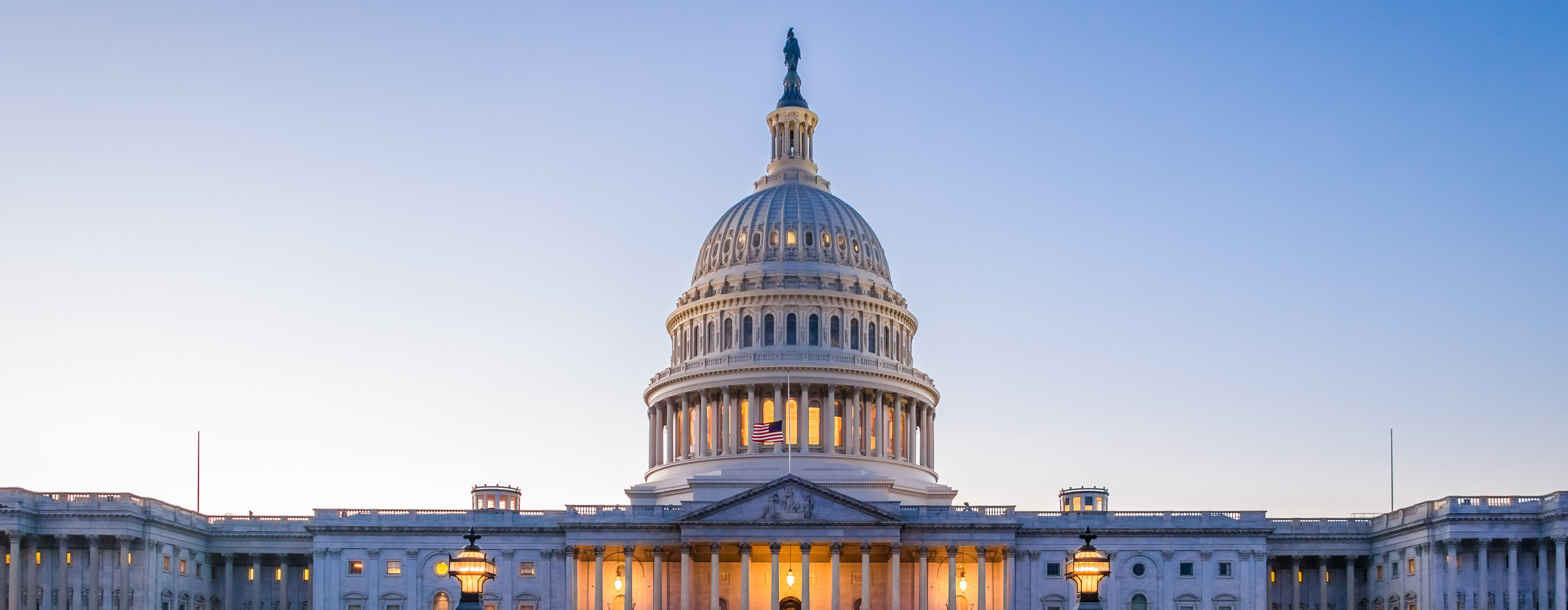
Last night, President Trump fulfilled his constitutional obligation to report to Congress on the state of the nation, delivering the first State of the Union address of his second term before a joint session and an audience of millions watching at home. The annual address carries outsized significance, offering President Trump a rare opportunity to speak directly to the country, set the legislative agenda and define the terms of debate for the year ahead and the critical midterm elections in November.
The evening was vintage Trump: a lengthy, freewheeling speech that frequently departed from the prepared text with numerous surprises and feel-good moments related to guests in the First Lady’s box. President Trump laid out an economic agenda largely focused on affordability and a muscular foreign policy agenda. Democrats, led by Virginia Governor Abigail Spanberger, drove a sharp counter-message, arguing that he has failed to deliver on his core promise of making American life more affordable and accusing the President of corruption.
Highlight Analysis of President Trump’s Policy Proposals
President Trump outlined an economic agenda centered on lowering costs for working families while highlighting what he described as the Administration’s economic successes. He pointed to regional declines in consumer prices—including eggs and gasoline—along with record stock market highs, which he said are strengthening pensions and 401(k) accounts, and emphasized job creation under his Administration. Nearly all of the economic policies President Trump mentioned were centered on the overarching goal of a more affordable America.
Attendees and Guests of Honor
President Trump invited several guests to reinforce key themes in the address, including affordability, immigration and military service. Guests included Erika Kirk (widow of the late Charlie Kirk), Evalea and Gary Beckstrom (parents of the late U.S. Army Specialist Sarah Beckstrom), Dalilah Coleman and members of the U.S. Men’s National Ice Hockey Team. First Lady Melania Trump invited Sierra A. Burns and Everest Nevraumont to the First Lady’s Box, reflecting her focus on foster youth and AI.
Democratic Members of Congress brought a variety of guests to highlight several key themes, including health care, affordability, immigration and the Epstein Files.
Banking and Financial Services
Although the Administration has touted proposals in the financial services industry to alleviate high consumer costs and housing prices, President Trump only touched on a few plans. He called on Congress to pass a ban on large institutional investors purchasing single-family housing. Treasury Secretary Bessent is meeting with House Financial Services Republicans this week to push for the inclusion of the institutional investors ban in any housing package. Senate Banking Chair Tim Scott has already expressed his willingness to include such a ban. Democrats are likely to continue scrutinizing the role of private equity in housing markets.
President Trump announced that Vice President Vance will lead a “War on Fraud,” suggesting combating financial fraud will help balance the federal budget. President Trump cited financial fraud found in Minnesota, Maine and Massachusetts as evidence efforts are necessary. Efforts are ongoing at the Department of the Treasury to identify and stop illicit financial activities, and it is expected the Vice President will directly coordinate with Treasury Secretary Bessent and Homeland Security Secretary Noem.
President Trump also reiterated his support to ban members of Congress from stock trading. A stock trading ban for members of Congress maintains bipartisan support; however, party leaders have thus far not been able to reach an agreement on the details of a ban.
Controversial policy proposals on rate caps, credit card fees and debanking undocumented immigrants were not raised. The President also did not mention cryptocurrencies or financial technology actions.
Energy
President Trump made several mentions of his Administration’s energy policies aimed at increased fossil production. Noting sustained and unprecedented levels of domestic natural gas production, President Trump tied U.S. dominance in the natural gas sector directly to his “drill, baby, drill” energy policies. He celebrated that U.S. domestic oil production has increased by over 600,000 barrels per day as well as the acquisition of more than 80 million barrels of oil from our “friend and partner” Venezuela.
Continuing with the theme of energy affordability, President Trump announced the “ratepayer protection pledge,” an agreement negotiated by the White House with hyper scalers whereby “major tech companies” will provide their own power. Citing the nation’s “old grid,” President Trump noted his belief that this pledge will prevent utility bill increases–and could further decrease costs–for Americans. While estimates are far-ranging, some suggest U.S. data center power demand could reach 130 GW by 2030, up from roughly 17 GW in 2022.
The “bring your own power” solution is an increasingly popular one, but critics are likely to call for details on the substance and implementation of such a pledge, particularly because of the variety of ways and jurisdictions in which a company could seek to build generation, pay for infrastructure upgrades and utilize tools like demand response. Permitting delays may continue to present challenges for data center build-out in these scenarios too. We anticipate a formal ceremony launching the “ratepayer protection pledge” at the White House in the coming days.
Calls by Republican energy leaders, like Sen. Capito (R-WV) and Rep. Bruce Westerman (R-AR), for President Trump to ask Congress to send a permitting reform bill to his desk were not answered during the President’s remarks.
Health Care
President Trump criticized Democrats and the Affordable Care Act for causing rising health care prices and highlighted that his Administration’s “Great Healthcare Plan” will lower healthcare costs and shift premium support from insurance companies to individuals. He also celebrated the reduced prescription drug list prices that the Administration says were secured through TrumpRx and called on Congress to codify his Most Favored Nation (MFN) pricing model into law. It is unlikely that congressional leaders will work together on a bipartisan basis to advance major legislation to address health care costs, including the expired enhanced premium tax credits and prescription drug prices. However, in a speech relatively light on reconciliation-eligible policy proposals, many of these health care items stand out as potential items for consideration should Republicans choose to pursue a second bill.
Immigration and the DHS Shutdown
Nearly two weeks into the partial government shutdown affecting the Department of Homeland Security (DHS), President Trump used his address to strongly defend the Administration’s immigration enforcement policies and sharply blame Democrats for the impasse, calling for the full and immediate restoration of DHS funding. His remarks come as Democrats and the White House continue to exchange proposals to reform U.S. Immigration and Customs Enforcement (ICE) policies in an effort to secure the votes needed to reopen the Department.
In the wake of President Trump’s speech, a near-term agreement between Democrats and Republicans appears unlikely. That said, growing disruptions at the Transportation Security Administration—and the resulting impact on air travelers—could increase pressure on both sides to reach a deal sooner rather than later.
President Trump also called for ending sanctuary city policies and for passage of Delilah’s Law, which he said would bar states from issuing commercial driver’s licenses to undocumented immigrants.
Tariffs
President Trump portrayed tariffs as a core policy success, arguing they have helped drive market gains, generated revenue for Administration priorities and strengthened U.S. leverage in trade negotiations.
The President was critical of the Supreme Court’s recent ruling striking down the Administration’s International Emergency Economic Powers Act (IEEPA) tariffs, while standing just a few feet away from three Justices who voted to overrule the policy. At the same time, he made clear that the decision would not deter his broader tariff agenda and indicated the Administration would continue pursuing tariffs under alternative legal authorities. There was little to no specific commentary regarding the rising debate over refunds for these overturned tariffs.
He also pointed to the Administration’s use of Section 122 tariffs—announced in the wake of the Court’s ruling—as a way to preserve tariff leverage without immediate congressional action. In doing so, he signaled that the tariff framework may need to be rebuilt, but that the White House does not intend to back away from tariffs. The Administration continues to view tariffs as a long-term feature of U.S. economic policy, with President Trump reiterating his view that tariffs could eventually replace income taxes.
This position was as expected – the Section 122 tariffs, which are capped at 15% and limited to no more than 150 days – are intended to act as a temporary bridge until further trade actions that require additional process (such as Section 232 and Section 301 investigations) are completed and implemented. The context of these Section 122 tariffs in particular is relatively novel and may yet see further legal consideration. Critics have already argued Section 122 tariffs must consist of a “balance of payments” deficit.
Tax
President Trump spent ample time taking a victory lap on the One, Big, Beautiful Bill Act (OBBBA), with a particular focus on its tax cuts and permanent extension of the Tax Cuts and Jobs Act (TCJA), which he described as the “largest tax cut in American history.” He thanked Republicans for passing the law and criticized Democrats for voting against it, suggesting the opposing party wants to raise taxes.
In looking back at OBBBA, he primarily focused on key Trump Administration priorities that were included in the legislation, including no tax on tips, no tax on Social Security, no tax on overtime, no tax on auto loans and Trump Accounts.
President Trump made no specific or definitive comments either for or against a second reconciliation package for Republicans, an increasingly challenging prospect given the tight margins in both bodies; moreover, relatively few of the new policy proposals he urged Congress to enact would seem procedurally appropriate for reconciliation. However, his choice not to discourage reconciliation, in contrast to some reporting in recent weeks, leaves the door cracked open for interested Republican members and leaders to continue exploring the possibility of a narrow reconciliation package, which will be a likely item for discussion on the House Republican retreat agenda this weekend.
While not referring to it by name, President Trump also highlighted the forthcoming Saver’s Match program and (likely regulatory) expansions his Administration may pursue. Enacted in the SECURE 2.0 legislation in 2022 (Division T of the Consolidated Appropriations Act 2022), the Saver’s Match was a bipartisan proposal to expand the existing Saver’s Tax Credit, previously a non-refundable 50% tax credit for contributions to a retirement plan of up to $1,000. Beginning in 2027, Saver’s Match expanded the program, effectively making the credit refundable for low- and moderate-income workers and providing a government-funded matching contribution to their retirement accounts. Individuals with adjusted gross incomes below $20,500 ($41,000 for joint filers), will qualify for a maximum $1,000 matching contribution regardless of their tax liability. While details on pending regulatory changes are still preliminary, the Administration is reportedly looking to make the program more accessible for Americans without employer plans and seek to allow new flexibility for philanthropic contributions.
Summary of the Democratic Response
Following the address, Virginia’s newly elected Governor Abigail Spanberger offered a Democratic rebuttal, a tradition that has been carried out by the opposition party since 1966, and California Senator Alex Padilla delivered a response in Spanish. In addition, some Democrats boycotted the speech and held a “People’s State of the Union” rally outside the Capitol.
Democrats’ response to President Trump’s address focused largely on a three-part critique: costs, chaos and corruption. Across their messaging, Democrats argued that the Administration and congressional Republicans have made daily life more expensive for working families—especially on health care, housing and other household costs—while prioritizing tax breaks and benefits for wealthy individuals and special interests. They also emphasized tariffs as a key line of attack, framing them as a tax on consumers that raises prices, creates uncertainty for businesses and hurts everyday Americans.
Democrats also concentrated on what they described as a broader pattern of instability and abuse of power. They argued that the Administration has created disruption at home through overly aggressive immigration enforcement tactics and uneven governance. At the same time, they leaned heavily into a corruption message, accusing President Trump and allies of normalizing pay-to-play politics, protecting political friends and undermining democratic institutions and constitutional norms.