
The playbook for the lame-duck session and the 120th Congress.
The election is over, but for companies and organizations with a stake in Washington or state capitals, this is no time to sit on the sidelines.
The weeks between Election Day and January present two distinct opportunities: advancing priorities while the current Congress finishes its work and positioning your organization for the new political landscape taking shape in Washington and across the states.
The organizations that navigate both effectively will enter 2027 with an advantage.
Democrats are poised to control both chambers of the 120th Congress, reshaping the legislative agenda and congressional oversight. Meanwhile, newly elected and reelected governors and state lawmakers are preparing their own priorities for 2027.
The Lame-Duck Opportunity
It’s a mistake to view the weeks between Election Day and January as little more than a waiting period.
The current Congress still has important work to finish: government funding must be addressed by December 11 to avoid a shutdown, the annual National Defense Authorization Act (NDAA) remains a priority, and opportunities for permitting reform and a Farm Bill remain uncertain.
That creates a short but meaningful window for companies and organizations. Three questions should guide their immediate strategy:

1: Is there a year-end legislative vehicle relevant to us?
Year-end negotiations often create opportunities for issues that cannot move independently. For organizations with appropriations, tax, agriculture, defense, infrastructure, permitting or other legislative priorities, the next several weeks are the time to determine whether an existing ask has a viable path onto a moving vehicle.
2: Who’s in the room where it happens today, not just next year?
The lawmakers and congressional leaders making decisions in December may not be the same people holding power in January. Don’t abandon outgoing leadership in the rush to engage newly elected officials.
Retiring and defeated lawmakers may also have greater freedom to support bipartisan agreements during their final weeks in office. Engagement with current committee leaders and influential members can still produce results.
3: What happens if Congress doesn’t act?
Not every outstanding issue will make it across the finish line, so develop your January strategy now for anything that does not. Organizations should be pursuing opportunities with the 119th Congress while preparing to advance unfinished priorities when the 120th Congress convenes on January 3.
Then Comes the Rest
January is a different opportunity entirely. A new Congress means new members, new committee chairs, new staff and new priorities. It also means hundreds of relationships are being established or reset simultaneously.
Some of the most valuable conversations during this transition may be the ones where you aren’t asking for anything.
New lawmakers, governors, and their staff will spend the coming months getting up to speed on the industries, employers, and issues they’ll be responsible for overseeing. That creates an opportunity for companies and organizations to introduce themselves, explain their economic and community impact, and offer their expertise.
Rather than waiting until a legislative fight is underway, use this period to establish relationships through introductory meetings, facility visits, and locally focused outreach. The goal is to become a trusted resource before you need something.
Follow the Issues that Moved Voters
The election also sent a message about the issues likely to dominate policymaking in 2027.
Affordability was front and center, and companies should expect lawmakers in both parties to evaluate proposals through their impact on household costs, jobs and economic security.
That means organizations need to do more than explain what they want from government. They need to demonstrate how their priorities benefit the people elected officials represent.
Debates over data centers and AI infrastructure also illustrate how concerns about community impact, costs and accountability can shape policy discussions across party lines.
Whatever your policy priorities, be prepared to answer a fundamental question: How will this benefit consumers, workers, businesses, and communities? That is the language policymakers will increasingly expect to hear in 2027.

Prepare for More Oversight
Engagement with the new Congress shouldn’t focus exclusively on advancing legislation. Companies in heavily regulated or politically visible industries should also assess their potential exposure to congressional oversight.
The incoming Democratic Congress is expected to pair an affordability-focused legislative agenda with more aggressive oversight of the Trump Administration. That scrutiny will not be exclusive to the administration and federal agencies. Companies and outside organizations should be prepared for congressional letters, requests for testimony, and subpoenas as committees investigate issues involving the administration and private industry.
Government affairs, legal, and communications teams should be working together now to identify vulnerabilities, align on messaging, and establish response protocols before an inquiry arrives.
Washington is Only Part of the Story
The political reset extends well beyond Washington. New governors, state legislators, attorneys general and other officials are preparing to take office across the country, bringing new priorities and potentially different approaches to regulation, economic development and business policy.
For companies operating in multiple markets, a shift in Washington may have very different implications in Texas, Georgia, Colorado or Pennsylvania. Understanding those differences, and maintaining relationships at the federal, state, and local levels, will be essential.
Political transitions also reinforce the value of bipartisan relationships that endure regardless of which party holds power.

The state capitols of Maryland, Texas, and Louisiana.
The Bottom Line
The organizations best positioned for 2027 won’t be the ones that wait until the first major legislative fight to engage. They’ll be the ones that use the transition to pursue immediate opportunities, understand the changing political landscape, and establish themselves as credible partners to policymakers.
Elections change who holds power, but they don’t change the importance of relationships, preparation, and engagement.
The campaign may be over. The work that comes next is just beginning. Do not throw away your shot!


Cornerstone Public Affairs’ David Ramsey speaks to students at the University of Mississippi
Cornerstone’s very own David Ramsey, public affairs associate in our Atlanta, GA office, spoke with students from the University of Mississippi’s Trent Lott Leadership Institute, alongside fellow alumni.

The panel focused on the different directions their careers have taken despite having the same degree, networking authentically, navigating uncertainty after graduation, and the campus involvement opportunities that contributed to career paths.
We’re proud that David could represent Cornerstone on this panel. Hotty Toddy!
Cornerstone’s David Ramsey speaking with students from the Trent Lott Leadership Institute.
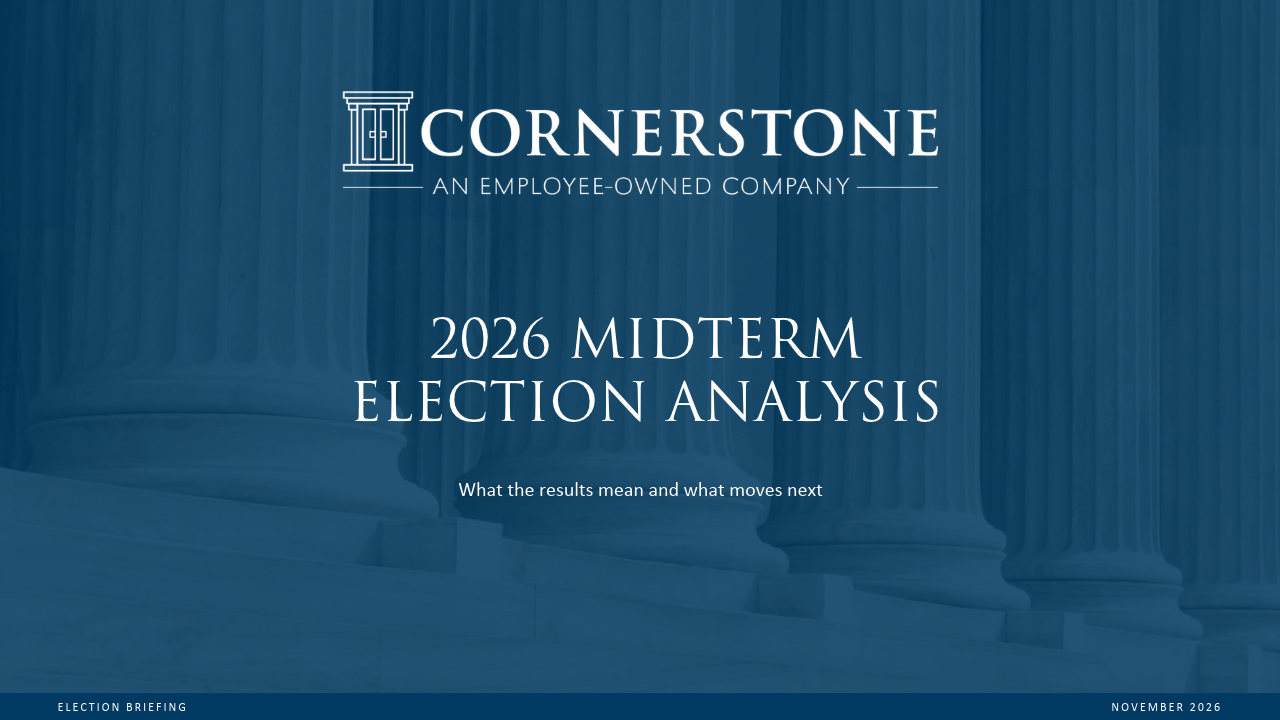
Cornerstone Government Affairs Launches 2026 Election Resource Center
Cornerstone Government Affairs has released our comprehensive analysis of the results of the 2026 Midterm Election. This includes industry-level breakdown, state insights, and an executive briefing with a concise overview of key takeaways.
We’re grateful to our colleagues who dedicated hours to produce these resources in a quick turn after the midterms!
Want to be first to receive news from The Briefing Room? Subscribe to the e-newsletter here. To learn more about Cornerstone’s Public Affairs and Strategic Communications offerings, please click here.